History
Main article: History of Moldova
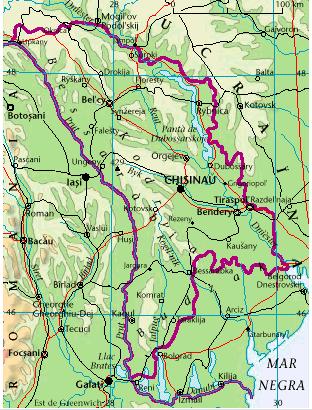
Moldova's territory was inhabited in ancient times by Dacians. Due to its strategic location on a route between Asia and Europe, Moldova has suffered from several invasions, including those of the Huns, the Kievan Rus' and the Mongols. During the Middle Ages the territory of Republic of Moldova, that of the Chernivtsi oblast and Budjak of Ukraine, as well as that of the eastern 8 of the 41 counties of Romania comprised the Principality of Moldavia (which, like the present-day republic, was known in Romanian as Moldova). The principality became a tributary to the Ottoman Empire during the 16th century. According to the Treaty of Bucharest in 1812, the territory, including Khotyn and Budjak (Southern Bessarabia), passed to the Russian Empire. At first, the Russians used the name "Guberniya of Moldova and Bessarabia", but later called it simply Bessarabia. While the northeastern part of Moldavia, called Bukovina, was similarly annexed by the Habsburg Empire, the western part (of Moldavia) remained an autonomous principality, and in 1859, united with Wallachia to form the Old Kingdom of Romania. Russian Tsarist authorities brought Bessarabia colonists such as Gagauz and Bulgars from the Ottoman Empire, Ukrainians from Podolia, Germans from the Rhine regions, and encouraged the settlement of Lipovans from Russia, Jews from Podolia and Galicia, as well as Russian nobles or retired military. The Tsarist policy in Bessarabia was also partly aimed at de-nationalization of the Romanian element by forbidding after 1860s education and mass in Romanian, the effect of which was a low literacy rate (approx. 40% for males, approx. 10% for females) rather than a denationalization. Following the Russian Revolution of 1917, Bessarabia proclaimed independence from Russia in 1918, and united with the Kingdom of Romania the same year. Transnistria did not join Romania and formed the Moldavian ASSR (1924-1940).
Ştefan cel Mare; Ştefan cel Mare şi Sfânt, "Stephen the Great and Holy" in more modern versions) was Prince of Moldavia between 1457 and 1504 and the most prominent repesentative of the House of Muşat
On June 28, 1940, in accordance with the secret protocol of the Ribbentrop-Molotov Pact with Nazi Germany, the Soviet Union forced Romania to evacuate its administration from Bessarabia and Northern Bukovina and immediately annexed these territories. The southern and northern parts (which had significant Slavic and Turkic minorities) were transferred to the Ukrainian SSR. At the same time, Transnistria (where ethnic Romanians were the largest ethnic group), was joined with the remaining territory to form the Moldavian Soviet Socialist Republic, coterminous with the present-day Moldova. Although Soviet troops were forced out in 1941 by the invasion of Axis forces, and Romania re-established the administration, the Soviet Union re-conquered and re-annexed the area in August 1944. Soviet rule brought a harsh de-nationalization policy, and an almost complete destruction of the local intelligentsia and of the richer farmers. A large number of ethnic Russians and Ukrainians (commonly known as Rusophones) immigrated into the new Soviet republic, especially into urbanized areas, while large numbers of ethnic Romanians were deported to Siberia and Kazakhstan during the early years of Soviet rule. The Soviet government began a campaign to promote a Moldovan ethnic identity, different from that of the Romanians, based on a theory developed during the existence of the Moldovan ASSR. Official Soviet policy asserted that the Moldovan was distinct from the Romanian language. Moldovan was written in Cyrillic alphabet, in contrast with Romanian, which was written in Latin alphabet (the language had used a different variant of the Cyrillic alphabet before 1860; as do many languages, Moldovan incorporated slight changes to the Cyrillic alphabet — which is commonly thought of as "the Russian alphabet" — most notably, the use of the letter zhe with a breve. During 1946-47, due to absence of many farmers (enrolled into the Soviet army) to work the fields, and to high quotas of agricultural products demanded by the Soviets from the farmers, Moldova suffered from the worst famine in its history, resulting in 298,500 deaths. In 1944-50, there were up to a dozen anti-communist resistance groups activating in Moldova, however KGB managed to uproot them by arrests and deportation. In 1965-1972, there was an attempt by a number of local intellectuals and students to create a movement for promotion of the Romanian culture and forcing the state to employ more Romanians in the government, but the KGB managed to crack down on it as well. In 1970s and 1980s, Moldavian SSR received substantial investment from the budget of the USSR to develop industrial and scientific facilities, as well as housing. In 1971, the Council of Ministers of the USSR adopted a decision "About the measures for further development of Kishinev city" that secured more than one billion rubles of investment from the USSR budget. Subsequent decisions also directed substantial funding and brought highly qualified specialists from all over the USSR to develop Moldova's industry. These investments stopped in 1991 with the dissolution of the Soviet Union, when Moldova became independent.
Along with the other peripheral Soviet republics, Moldova started to move towards independence from 1988 onwards; in August 1989 a language law was passed, adopting the Latin alphabet for Moldovan and declaring it the state language of the MSSR [3]. The first free elections for the local parliament were held in February and March 1990. In August 1991, Moldova declared its independence, and in December of that year became a member of the post-Soviet Commonwealth of Independent States along with most of the former Soviet republics, although declaring itself a neutral state, it did not join the Commonwealth of Independent States (CIS) military branch. At the end of that year, an ex-communist reformer, Mircea Snegur, won an unchallenged election for the presidency. Three months later, the country achieved formal recognition as an independent state at the United Nations. The part of Moldova east of the Dniester River, Transnistria, which included a larger proportion of ethnic Russians and Ukrainians— claimed independence in 1990, fearing the rise of nationalism in Moldova and the country's expected unification with Romania at the dissolution of the USSR. This caused a brief military conflict between Moldova and Transnistria in 1992. Russian forces intervened on the Transnistrian side, and Russian troops of the 14th Army remain there to this day. Negotiations between the Transnistrian and Moldovan leaders have been going on under the mediation of OSCE, Russia, Ukraine, European Union, and USA. Despite expectations of the Popular Front of Moldova, Moldova did not unite with Romania in 1991. In the early 1990s, the future of Moldova was a source of tension in Romania's relations with Russia. A March 1994 referendum of the new constitution saw an overwhelming majority of voters favoring continued independence. In 2001, the country became a member of the WTO. During the first 10 years of independence, Moldova was governed by coalitions of different parties, lead mostly by former communist officials which turned to democracy. In the 2001 elections, the Communist Party of Moldova won the majority of seats in the Parliament and appointed Vladimir Voronin as president. After few years in power, relationships between Moldova and Russia deteriorated in November 2003 over the Transnistrian conflict. In the following election, held in 2005, the Communist party made a 180 degree turn and was re-elected on a pro-Western platform, with Voronin being re-elected to a second term as a president. After 1999-2001, Moldova has constantly affirmed its desire to join the European Union, however it is not even part of the accession process yet, and the country's internal and foreign trade policy remains divided between the influence of Russia and that of the EU and USA.
Government
Main article: Politics of Moldova
The Republic of Moldova is a relatively new state, which became independent after the break-up of the former Soviet Union. Historically, it traces its statehood to the medieval Principality of Moldavia (jointly with an equal size territory inside Romania), and to the Moldavian Democratic Republic (1917-1918), which chose to join Romania in 1918. In 1940, the Soviets created a puppet government under the name Moldavian SSR, which they placed inside the USSR as one of the 15 soviet republics. On 23 June 1990, the first democratically elected parliament proclaimed Moldova's sovereignty, and on 27 August 1991 the country's separation from the USSR, and independence.
Political system
The unicameral Moldovan parliament (Parlament) has 101 seats, and its members are elected by popular vote every four years. The parliament then elects a president, who functions as the head of state. The president appoints a prime minister as head of government who in turn assembles a cabinet, both subject to parliamentary approval. There is a large variety of political parties and movements in Moldova. As of 2007, the major parties and movements are:[citation needed]
Party of Communists of the Republic of Moldova
Popular Christian Democratic Front
Movement for a Democratic and Prosperous Moldova
Democratic Forces Party
Party of Renaissance and Conciliation
Social Democratic party of Moldova
Liberal Party of Moldova
2001 Parliamentary Elections
Party of Communists of the Republic of Moldova (PCRM) (50.07% votes, 71 mandates)
Electoral Bloc "Braghiş Alliance" (BEAB) (13.36% votes, 19 mandates)
Christian Democratic People's Party (CDPP) (8.24% votes, 11 mandates)
2005 Parliamentary Elections
Party of Communists of the Republic of Moldova (PCRM) (45.98% votes, 56 mandates)
Electoral Bloc “Moldova Democrată” (BMD) (28.53% votes, 34 mandates)
Christian Democratic People's Party (CDPP) (9.07% votes, 11 mandates)
Relations with Romania/Identity Politics
Main article: Relations of Moldova with Romania
In 1989, Romanian became the official language of Moldova (former Romanian Bessarabia). Following independence in 1991, the Romanian tricolor with a coat-of-arms was used as the flag, and Deşteaptă-te române!, the Romanian national anthem, also became the anthem of Moldova. In those times, there was an expectation among certain groups in both countries that they were to be united soon, and a Movement for unification of Romania and the Republic of Moldova began in both countries in the early 1990s. Dual citizenship became an increasingly important issue following the 2003 local elections, and in November 2003, the Moldovan parliament passed a law that allowed Moldovans to acquire dual citizenship.
In the address to the Romanian parliament in February 1991, Mircea Snegur, the Moldovan president spoke about a common identity of the Moldovans and Romanians, referring to the "Romanians of both sides of the Prut River" and "Sacred Romanian lands occupied by the Soviets". Historically, the Romanian government had provided scholarships to Moldovan students (via a common scheme with the Moldovan Ministry of Education) at all educational levels to attend Romanian schools and universities.
However, the initial enthusiasm in Moldova was tempered and, starting in 1993, Moldova started to distance itself from Romania. The constitution adopted in 1994 used the term "Moldovan language" instead of "Romanian" and changed the national anthem to Limba noastră. The 1996 attempt by Moldovan president Mircea Snegur to change the official language to "Romanian" was dismissed by the Moldovan Parliament as "promoting Romanian expansionism".

Abonați-vă la:
Postare comentarii (Atom)

Niciun comentariu:
Trimiteți un comentariu