Mihai Eminescu, national poet of Moldova and Romania.
Main article: Culture of Moldova
Located geographically at the crossroads of Latin and Slavic cultures, Moldova has enriched its own culture adopting and maintaining some of the traditions of its neighbors.
The Prince Dimitrie Cantemir is one of the most important figures of Moldavian culture of the 18th century. Cantemir wrote the first geographical, ethnographical and economic description of the country in Descriptio Moldaviae (Berlin, 1714).
Mihai Eminescu was a late romantic poet, probably the best-known and most influential Romanian language poet.
Language
Main articles: Moldovan language and Romanian language
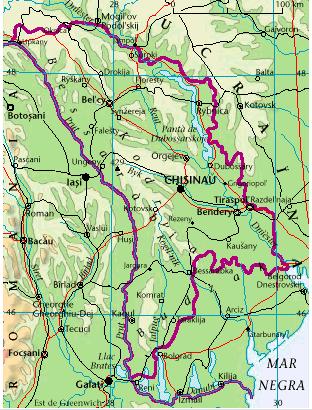
The state language, according to Title I, Article 13 of the Moldovan Constitution, is Moldovan. In Moldova's Declaration of Independence, the same language is called Romanian[10]. There is no particular linguistic break at the Prut River, which divides Moldova from Romania. In formal use, the languages are identical except for minor orthographical issues (the Moldovans often, but not always, write î in some contexts where Romanians would use â; this same form used to be normal in Romania until 1993). There is, however, some regional variation, as might be found within any linguistic territory, and the common speech of areas such as Chişinău or Transnistria can be distinguished from the speech of Iaşi, a Romanian city that is also part of the former Principality of Moldavia, while the difference in the common speech between Iaşi and the capital of Romania Bucharest is even greater. Linguistically, Moldovan is considered one the the five major spoken dialects of Romanian, all five being written identically. In general, before 1988-89, the less educated, the greater the difference from standard Romanian, and the more words were borrowed ad hoc from Russian into the daily speech.
Opinions vary on the status of Moldovan as a language. Most linguists consider standard Moldovan to be identical to standard Romanian, an Eastern Romance language, although one Moldovan linguist[11] disputes this. There are, however, more differences between the colloquial spoken languages of Moldova and Romania, most significantly due to the influence of Russian in Moldova which was not present in Romania. These differences in speech vocabulary are being slowly diluted after 1989. The matter of whether or not Moldovan is a separate language is a contested political issue within and beyond the Republic of Moldova. The 1989 law on language of the Moldavian SSR, which is still effective in Moldova according to the Constitution , asserts the existence of "linguistic Moldo-Romanian identity". A significant minority speaks native Russian, and there are more Slavicisms in common speech in Moldova than in common speech in Romania. Nonetheless, Moldovans are generally aware when they are using a word of Slavic origin not found in common Romanian, and are capable of choosing whether or not to use these words in a particular context.
In some cases Russian is used alongside Moldovan (Romanian) within state institutions, despite not having legal status. This is generally in direct relation to the political context in the government, which can be either pro-Russian or pro-Romanian/pro-Western. As of 2006, five members of the Moldovan government were not able to speak Moldovan, the main language used in government meetings being Russian. In Transnistria, the breakaway authorities consider its old Cyrillic form co-official with Russian and Ukrainian, and persecute inhabitants that use the standard Latin alphabet.

Abonați-vă la:
Postare comentarii (Atom)

Niciun comentariu:
Trimiteți un comentariu